
Carbon fiber has become an essential material in a wide variety of industries due to its strength, lightness, and versatility. To choose wisely, match weave to load paths, mold form, and finish requirements for your project.
Carbon fiber fabric consists of a sheet of closely woven carbon fibers, which are thin, long strands of carbon atoms. Craftsmen begin with a precursor, typically polyacrylonitrile or pitch. They heat and stretch it incrementally above 1,000 degrees Celsius to expel non-carbon elements and align the carbon atoms. The outcome is a thread with excellent tensile strength and minimal weight. These filaments are gathered into tows, such as 3k, 6k, or 12k, where ‘k’ equals 1,000 filaments, and woven into fabric.
In use, the carbon fiber fabric doesn’t exist by itself. It usually combines with a resin to create a composite called carbon fiber reinforced polymer (CFRP). The fabric provides strength and stiffness, while the resin bonds layers, distributes load, and maintains form. Epoxy is typical for high-performance pieces, whereas vinyl ester or polyester may suffice for price-concerned constructions. The resin choice, cure cycle, and fiber volume fraction all shift final properties. More fibers per unit volume generally translates to greater stiffness and strength, but there is less space available for resin flow.
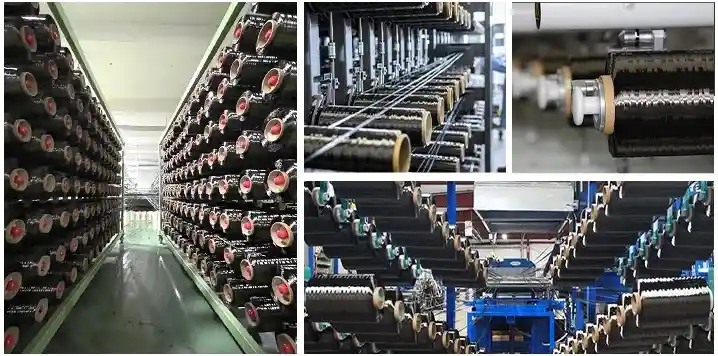
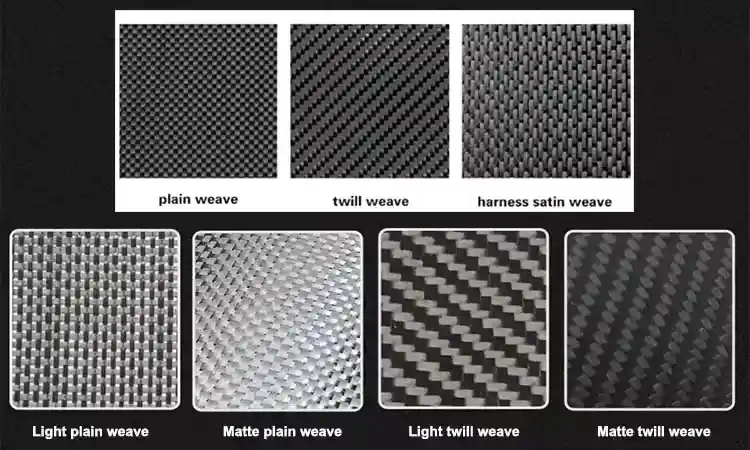
Carbon fiber fabrics vary by weave style, tow size, and mode of load transfer through the laminate. This selection influences drape, surface finish, stiffness, and impact response. Producers have developed rigorous processes to control quality since the 1970s, and engineers blend tensile strength and tensile modulus to custom fit requirements.
Plain weave interweaves warp and weft over and under in a very simple pattern. It’s shape-retentive, fray-resistant, and provides that crisp checkerboard pattern that adorns consumer panels and drone shells. The tight crimp caused by frequent yarn crossovers can reduce tensile modulus relative to looser weaves. It enhances stability during layup, something that is especially helpful in hand lay and small molds.
It operates on small-tow fibers (3K or 6K) for a smooth finish or large-tow as much as 50K to control the price range in large parts. Use it for thin skins, repair patches, and wonky edges where the fibers need to hold their position.
Twill steps the crossover in a diagonal pattern, such as 2 times 2 or 3 times 1. Fewer crossovers minimize crimp, so tensile modulus and drape are better than plain weave. This lends itself to wrapping curved shapes like bike frames or fairings.
Surface features a distinct diagonal rib coveted for exposed-carbon components. With 12K to 50K tow, twill can cover large square meters fast and still drape like a dream. It strikes a balance between tensile strength and stiffness for general structural skins.
Satin weaves (4-harness, 5-harness, etc.) allow yarns to float over multiple neighbors before interlacing. Long floats cut crimp, raising in-plane modulus and providing a very smooth face. This can enhance fatigue life in plate-like panels, radomes, and marine decks.
They require gentle handling as longer floats can catch or pull out of alignment during layup. Tight process control on fiber alignment and resin flow is essential to maintain consistent properties across large panels.
Unidirectional (UD) fabric places the majority of fibers in one direction, with light binders or little weft. It provides extremely high tensile strength and modulus along the fiber axis, which is perfect for spars, stringers, and leaf springs. Off-axis properties are modest, so stacks employ angles of 0, ±45, and 90 degrees to adjust shear and transverse loads.
UD can leverage small-tow for high-end aerospace stiffness or large-tow, even 50K, for low-cost civil beams where volume counts. Designers customize layups to the precise strength and modulus blend required.
Spread tow flattens tows into ultra-thin tapes and then weaves them with low crimp. This results in high fiber volume, low resin pockets, and enhanced in-plane modulus. Surfaces are smoother and useful for aerodynamic skins and sporting goods.
It lightens without sacrificing strength. It is available in plain, twill-like, or specialized patterns. It is frequently combined with high-modulus grades for thin, stiff laminates.
Selection begins with what the part has to do, what you can afford, and how the finished surface should look and perform. Weave, tow size, areal weight, resin method, finish, you name it, tradeoffs are the norm.
Unidirectional fabric transmits force most efficiently along a single axis, so it’s appropriate for limbs and spars that experience axial loads like an archery bow or straight spar. To handle multi-axis loads in bike frames, drones, and brackets, woven fabrics (plain, twill, satin or harness) distribute stress among both warp and weft.
In auto parts, two by two twill is king. It combines that clean drape, excellent fatigue behavior, and the appearance designers desire. It has more tensile strength than plain weave, which benefits panels that experience flex or impact. Plain weave, one by one, locks yarns at every crossover, so it resists fray and holds shape, but it is less strong than two by two twill or a four harness satin, usually referred to as four by four. Apply it on flat skins, small covers, and thin, simple laminates.
Tighter weaves increase stability and drape less well. For molds with deep draws or tight curves, a more open twill or a satin weave can lay down with less wrinkling. Wet prepreg cloth is the best option for complicated shapes and thin walls since tack and controlled resin allow layup to be very precise.

Price scales with fiber quality, weave and finishing. Standard-modulus twill in 200 to 220 grams per square meter tends to strike a pretty good cost-performance balance for a lot of panels and fairings. Plain weave can be cheaper for flat sections, but it often requires additional plies to achieve the same stiffness.
Prepreg increases cost and reduces rework, increases fiber volume and reduces weight. For short runs, hand layup with wet resin and a 2 by 2 twill can be a good compromise.
When budgets are tight, use unidirectional plies only along the main load path and back them with a cheaper woven skin for handling and abrasion resistance.
Surface goals motivate weave selection. In auto work, one by one or two by two weaves are often considered to be best in appearance and construction. The two by two twill gives that trademark diagonal and camouflages seam steps better than plain. It stands up well to clear coats on exposed panels.
If it’s a paint or high wear part, concentrate on print-through control and durability. Satin or harness weaves can lay smooth over tight curves, but they can bruise if mistreated. Thus, careful debulk and vacuum are essential. If you’re after a matte technical aesthetic, select a peel-ply finish and forgo polish.
To wrap it all up, carbon fiber fabric is all about trade-offs. Twill provides sharp aesthetics and neat drapability. Plain weave stays in shape and fights fray. Satin drapes seamlessly on sharp bends. Spread tow saves racing weight. Uni provides robust tensile strength in a single direction. Hybrids mix goals, such as impact or thermal requirements.
So what do you say, ready to choose a roll? Tell us your application, dimensions and strength target.

Connect with an NQ expert to discuss your product needs and get started on your project.
Contact NowWhat is carbon fiber fabric used for?
Carbon fiber fabric fortifies composites for maximum strength with minimal weight. It’s prevalent in aerospace, automotive, marine, sports gear, and drones. It is utilized for structural reinforcement in construction. Advantages include stiffness, fatigue resistance, corrosion resistance, and low tare weight.
What are the main types of carbon fiber fabric?
Popular varieties are plain weave, twill weave, satin weave, UD (unidirectional), and multiaxial (biaxial, triaxial). Each has a different fiber orientation, drape, stability, and strength direction. Select based on load paths, part geometry, and finish requirements.
How does weave affect performance?
Weave controls drape, stability, and strength balance as well. Plain weave provides stability and tight crimp. Twill drapes well and looks smooth. Satin drapes best but is less stable. UD maximizes strength in a single direction. Multiaxial balances strength along axes.
What is unidirectional carbon fabric?
Unidirectional fabric has fibers predominantly going in one direction, with little cross yarns. It provides peak strength and stiffness along that axis. Apply when loads are known and directional, such as for spars, beams, and reinforcements in preferred orientations.
Do I need special resins or processing?
Best with epoxy, vinyl ester, or polyester resins. Epoxy tends to provide optimal strength and durability. Choose a process that fits your tools: hand layup, vacuum bagging, infusion, or prepreg with autoclave. Adhere to manufacturer cure schedules for best results.