
Carbon fiber felt, a non-woven material composed of randomly distributed chopped carbon fibers bonded through physical or chemical means, has become an indispensable functional reinforcement in the modern composites industry. The core of its physical properties lies in the high modulus, high strength, and excellent electrical and corrosion resistance of the carbon fibers themselves, while its non-woven structure provides isotropic mechanical performance within the plane. In materials science, carbon fiber felt is typically defined as a fiber network with high porosity, where fiber orientation is random at the microscopic level but demonstrates high uniformity macroscopically. This unique structure allows carbon fiber felt to serve as a surface or functional interlayer in fiber-reinforced plastics (FRP), improving surface quality, enhancing interlaminar properties, and providing conductive paths.
From an evolutionary perspective, early carbon fiber applications were concentrated on continuous fiber fabrics for high structural loads. However, as industrial demand for multifunctional materials grew—particularly for electromagnetic interference (EMI) shielding, static dissipation, chemical barriers, and fine surface finishes—non-woven carbon fiber materials like surface veils and pultrusion felts emerged. These felts are typically produced from polyacrylonitrile (PAN) or pitch-based carbon fiber precursors, subjected to high-temperature carbonization to ensure a carbon content usually above 90%, which guarantees chemical stability and conductive efficiency in extreme environments.
The manufacturing of carbon fiber felt is a high-precision process, primarily divided into wet-laid forming and dry-laid/needle-punching processes. The wet-laid process dominates in precision industries due to its ability to produce extremely thin and uniform surface veils.
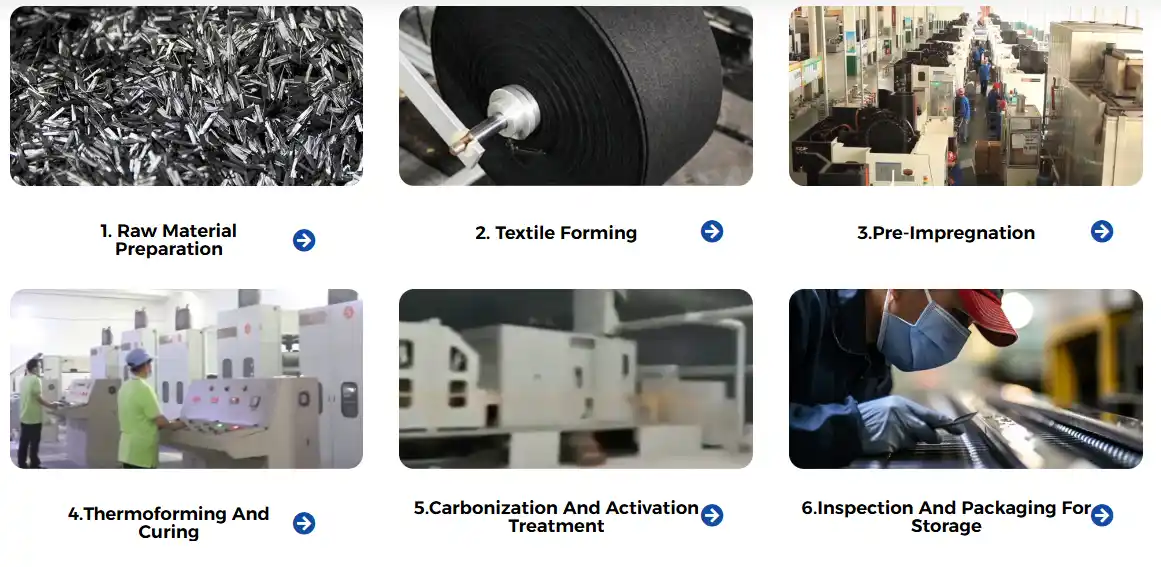
The wet-laid process is logically similar to traditional papermaking but involves higher material handling difficulty due to the nature of carbon fibers.
– Fiber Chopping and Dispersion: Carbon fibers are naturally hydrophobic and brittle, making them prone to clumping. Specialized chemical dispersants and mechanical agitation systems are used to ensure uniform dispersion at a molecular-like level.
– Web Forming: The dispersed fiber slurry is sprayed onto a high-speed rotating wire mesh via a headbox. Vacuum suction quickly removes the water, causing the fibers to interlace randomly to form a wet fiber film.
– Binder Impregnation: To give the dried felt sufficient handling strength, a binder is applied. Binders are categorized as polyester-based (soluble in resin) or epoxy-based (reactive with resin during co-curing).
– Drying and Curing: The wet web enters a drying line where residual water is removed and the binder is set at specific temperatures.
Compared to thin surface veils, heavy-weight felts like are designed to withstand significant mechanical stress, such as in pultrusion processes. These felts often require complex layering techniques or needle-punching reinforcement to ensure they do not break or shift under the high-tension environment of a pultrusion die. Thickness control is achieved through precise slurry flow meters and synchronized mesh speed systems.
In the niche market of carbon fiber felt, the pultruded variant is considered a high-performance specialized material, particularly for applications requiring high current-carrying capacity and structural integrity.
The “superior conductivity” of pultruded carbon fiber felt stems from its dense internal fiber contact points. Charge transport within the material follows Percolation Theory; when the fiber volume fraction reaches a certain threshold, resistivity drops sharply. A weight provides more conductive pathways per unit volume, making it exceptional for anti-static and EMI shielding applications.
For electromagnetic waves, felt exhibits a dual mechanism of absorption and reflection. When a wave hits the conductive layer, the dense fiber network induces eddy currents, dissipating electromagnetic energy as heat. According to the shielding effectiveness formula:
During the pultrusion process, reinforcements are subjected to continuous pulling force. carbon fiber felt provides not only electrical functionality but also structural reinforcement, increasing the transverse strength of the profiles. Once impregnated with resin, this felt shows excellent wet-out and compression resilience, ensuring a dense composite structure within the mold.
| Process Parameter | Performance of Felt in Pultrusion | Impact on Final Product |
|---|---|---|
| Wet-out Speed | Moderate, requires high-pressure impregnation | Reduced internal porosity |
| Pulling Resistance | Extremely high, no tearing | Continuous production guaranteed |
| Surface Hardness | Significantly improved | Enhanced impact resistance |
| Conductive Stability | Constant, no contact resistance fluctuations | Meets precision grounding needs |
Carbon fiber surface felt (Carbon Veil/Tissue) acts as the “skin” of a composite. Its primary role is not to bear structural loads but to optimize interface properties by creating a resin-rich layer.
In parts reinforced with glass or carbon fiber fabrics, non-uniform resin shrinkage can lead to “print-through” of the underlying weave pattern. Introducing a very thin carbon fiber surface veil (e.g., 10g/m² or 20g/m²) breaks the continuity of this pattern. Because the fibers in the veil are randomly oriented, they can hold more resin at the surface, creating a smooth, high-performance aesthetic finish.
In chemical storage tanks, pipes, and marine equipment, the surface veil directly contacts corrosive media. The natural chemical inertness of carbon fiber provides extra support for the resin layer. When environmental stress creates a tendency for micro-cracks, the short fibers in the veil act as “bridges” (Crack Bridging), preventing cracks from propagating deep into the structural layers. This mechanism significantly extends the service life of composites in extreme acid/alkali environments.
– 10g – 50g/m²: Used primarily for EMI shielding in precision electronics, automotive aesthetics, and corrosion-resistant liners.
– 100g – 200g/m²: Used for heating elements, floor heating components, and structural parts requiring moderate conductivity.
– 300g/m² and above: Targeted at pultrusion and compression molding for cable trays, specialized conductive profiles, and heavy-duty anti-corrosion components.
– Polyester Binder: Excellent solubility, suitable for unsaturated polyester and vinylester systems, common in hand lay-up and pultrusion.
– Epoxy Binder: High thermal stability, suitable for epoxy prepregs and vacuum infusion, ensuring maximum interfacial bond strength.
| Application Field | Recommended Weight | Core Function |
|---|---|---|
| Hydrogen Fuel Cells | 150 – 250g | Gas diffusion & conductivity |
| Satellite Radomes | 10 – 20g | Wave transparency & thermal control |
| Chemical Pickling Tanks | 30 – 50g | Anti-corrosion layer reinforcement |
| 5G Base Station Housing | 100g | EMI shielding & heat dissipation |
In composite skins of civil aircraft, carbon fiber surface veil is a key component of the Lightning Strike Protection (LSP) system. Working with metal meshes, it rapidly dissipates massive currents across the surface. Additionally, specialized felts can be developed for radar-absorbent stealth coatings.
In Proton Exchange Membrane Fuel Cells (PEMFC), carbon fiber felt is used as the Gas Diffusion Layer (GDL). It must offer high conductivity, gas permeability, and superior water management. In All-Vanadium Redox Flow Batteries, it serves as the electrode, providing a huge surface area for redox reactions.
In tennis rackets and golf clubs, surface veils reduce vibration and improve “feel.” In smartphones and laptops, ultra-thin veils are used for internal EMI shielding to prevent signal interference.
Carbon fiber felt and its variants, such as pultruded felt and ultra-thin surface veils, constitute the functional foundation of high-performance composites. Their superior conductivity, surface improvement capabilities, and unmatched chemical resistance make them irreplaceable across industries. As manufacturing refines and smart functionalities are integrated, carbon fiber felt will continue to lead composites toward a greener and more intelligent future.

Connect with an NQ expert to discuss your product needs and get started on your project.
Contact NowWhat are the main differences between carbon fiber felt, carbon fiber paper, and carbon fiber cloth?
The primary differences lie in their structure and manufacturing processes:
Carbon Fiber Cloth: Produced using continuous fibers through a woven process, offering high durability and flexibility.
Carbon Fiber Felt: Also a non-woven material, made of randomly distributed chopped fibers joined by mechanical entanglement (such as needle-punching) or chemical bonding. It has the highest porosity (often ) and is more compressible than paper because it typically does not contain a resin matrix.
Why does pultruded carbon fiber felt show superior electrical conductivity?
pultruded carbon fiber felt is considered an excellent conductive material for several reasons:
High Fiber Density: The high grammage of means the contact points between carbon fibers are extremely dense, creating a wealth of conductive pathways.
Percolation Effect: Charge transport follows Percolation Theory, where resistivity drops sharply once the fiber content reaches a specific threshold. The specification ensures high stability of electrical properties across various applications.
How do the wet-laid and needle-punching processes differ?
Wet-laid Process: Chopped fibers are dispersed in water to form a slurry, which is then formed into a web. This process excels at producing ultra-light, ultra-thin surface veils (typically 10g–50g/m²) with extremely uniform fiber distribution.
Needle-punching: This involves using needles with barbs to repeatedly puncture a fiber web, mechanically entangling the fibers. This process does not require chemical binders and is better suited for producing thicker, heavier felts (e.g., 100g–300g+) used in battery electrodes or heavy-duty filtration.
How does carbon fiber surface veil improve the quality of composite products?
Carbon fiber surface veil acts as a “surface tissue” to optimize the exterior of a product:
Eliminating Fiber Print-through: It covers coarse reinforcement fabrics and absorbs resin to create a smooth layer, preventing the underlying weave pattern from showing on the surface (fiber print-through).
Crack Prevention and Sealing: The randomly distributed fibers prevent micro-cracks in the surface resin and establish a chemical barrier to prevent the infiltration of corrosive media.
Added Functionality: It provides anti-static properties, wear resistance, and electromagnetic shielding to the surface without adding significant weight.
How does carbon fiber felt perform in harsh environments?
Corrosion Resistance: It is highly inert to strong acids (such as hydrofluoric and nitric acid), strong alkalis, and seawater, performing significantly better than glass fiber.
High-Temperature Tolerance: In non-oxidizing environments, carbon fiber felt can withstand temperatures up to 2500°C or higher without losing its properties.
Thermal Stability: It has a very low Coefficient of Thermal Expansion (CTE), ensuring the dimensional stability of products during extreme temperature fluctuations.