
In the frontier of modern industrial materials science, carbon fiber felt has evolved from a specialized insulation material for aerospace into a critical core component across environmental purification, high-performance composite manufacturing, and precision surface treatment. This report integrates process details from world-leading manufacturers and research institutions to deeply analyze the production flow, activation mechanisms, surface treatment technologies, and the application logic of carbon fiber felt in high-end industrial systems.
The manufacturing of carbon fiber felt is a complex interdisciplinary process involving polymer chemistry, thermodynamics, and mechanical engineering. The core of production lies in converting organic fiber precursors into carbon fiber aggregates with a graphitized microcrystalline structure through a series of precision-controlled thermal treatment steps.
PAN-based carbon fiber accounts for over 90% of global carbon fiber output due to its excellent comprehensive performance and mature production process. The form of the fiber preform largely determines the properties of the final composite material. The overall needle punching method is the mainstream technology for preparing PAN-based preoxidized fiber needle felt. This method uses a needle punching machine’s hooked needles to penetrate the fiber web, generating mechanical interlocking in the thickness direction (Z-direction) to form a three-dimensional structure.
For the production of viscose-based carbon fiber felt, the impregnation process is key to enhancing the final performance and carbonization efficiency. Raw viscose fiber cloth is screened and then enters an aqueous solution containing 1% diammonium phosphate ($ (NH_4)_2HPO_4 $) for approximately one hour of immersion. Diammonium phosphate acts as a high-efficiency flame retardant and catalyst, forming chemical bonds or chelates with cellulose molecules to promote intramolecular cyclization and intermolecular cross-linking. This prevents the escape of molecular fragments at high temperatures, thereby improving the shape stability and carbon yield of the fibers.
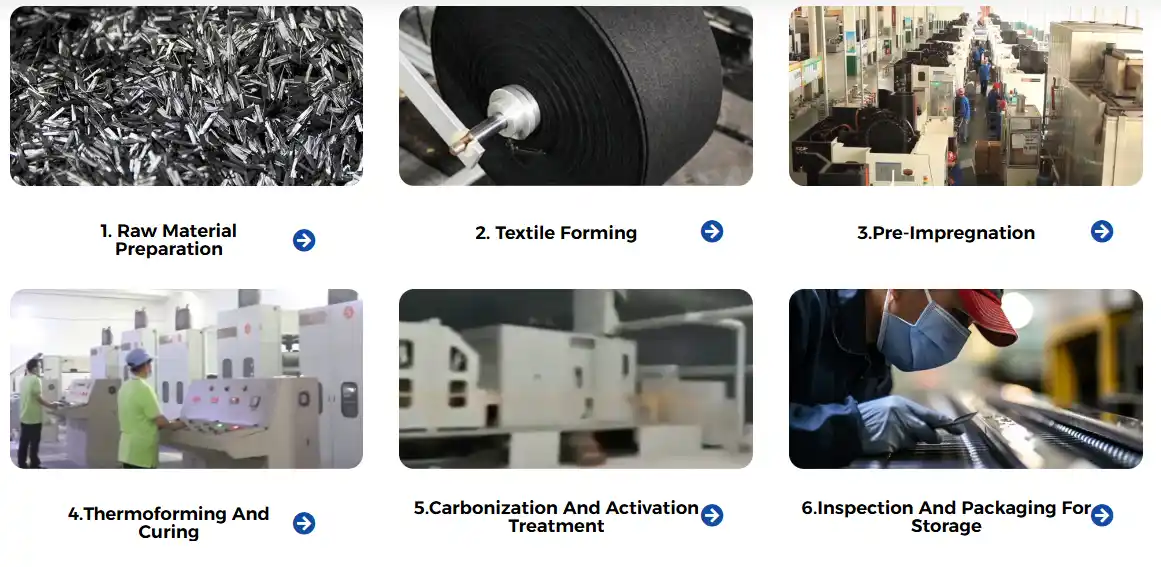
Carbonization is the decisive thermal treatment stage that converts pre-treated fibers into carbon fibers. This process is typically conducted under the protection of inert gases like nitrogen ($ N_2 $) to prevent oxidative combustion.
Low-temperature Carbonization Stage:
Dried fiber cloth is heated in a carbonization furnace to approximately 300–400°C. In this stage, physically adsorbed water is discharged before 130°C. Subsequently, between 270-400°C, the macromolecular main chains break, dehydrate, and undergo secondary cyclization reactions.3 For PAN-based fibers, the ladder-like polymer formed during pre-oxidation begins further cross-linking.
High-temperature Carbonization Stage:
As temperatures rise above 1000°C, non-carbon atoms (such as nitrogen, hydrogen, and oxygen) are discharged as gases like CO2, H2O, NH3, and N2. At this point, carbon elements gradually enrich, with carbon content exceeding 90%, forming a conjugated planar layer of six-membered ring structures similar to graphite microcrystals.
In the manufacturing of high-performance composites, carbon fiber surface felt (or tissue) acts as a functional auxiliary material, playing a vital role in improving surface quality, providing a conductive layer, and protecting structural fibers.
The resin infusion process (such as VARTM) places extremely high technical requirements on auxiliary materials. Carbon fiber surface felt, due to its high porosity and uniform fiber distribution, is often used as a flow media or surface masking material.
Resin System:
Exothermic reactions during infusion must be strictly controlled. By adjusting the proportion of initiators (like cumene hydroperoxide), gel time can be effectively extended to ensure full wetting of large, complex parts.
Fiber Mats and Reinforcements:
While woven fabrics provide structural strength, their tight weave can limit resin flow. In contrast, carbon fiber surface felts and random mats provide more pore space, significantly accelerating resin diffusion within the mold. In precision manufacturing, surface felt is often the first layer against the mold surface to hide “fiber print-through” from structural fabrics, resulting in a mirror-like finish.
Cores and Flow Media:
In sandwich structures, cores often require special surface treatments to act as distribution media.
Surface Grooving: Shallow grooves (e.g., $1.3mm$ wide $\times 3mm$ deep) are cut into the core surface to guide rapid resin spread.
Perforated Sheet: Holes in the thickness direction allow resin to flow between sides, ensuring synchronous wetting.
Hyperbolic Sheet: Cross-cut patterns increase core flexibility for better fitting to complex mold contours.
RTM technology is the core for achieving large-scale production of high-performance composites. Traditional RTM is evolving toward automation and high-pressure systems.

The German Aerospace Center (DLR) developed the EVo production line, showcasing the future of composite manufacturing. Designed to produce fuselage frames for next-generation aircraft like the Airbus A320, it has an annual capacity of 100,000 parts. Its modules include:
Automated Cutting and Laying: Robots pick and place materials based on digital files.
Preforming: Vacuum membranes and infrared heating activate powder binders to stabilize the preform.
Precision Trimming: Trimming preforms to near-zero tolerance to prevent resin “dry spots” caused by uneven channels during injection.
HP-RTM was developed for the high-efficiency needs of the automotive industry. Highly active resin is mixed under high pressure and injected into a vacuum-sealed mold containing pre-placed carbon fiber mats or fabrics.
Process Advantages: Extremely short molding cycles (often minutes), very low porosity, and superior surface quality.
Industry Applications: BMW has widely applied HP-RTM for carbon fiber roofs on the M3, the Life module of the i3, and structural components of the 7 Series.
Activated Carbon Fiber Felt (ACF) exhibits superior performance over traditional granular activated carbon in environmental purification due to its unique pore structure and massive specific surface area.
The advantages of ACF stem from its fibrous morphology and micropores that are directly exposed on the surface, making adsorption kinetics extremely fast.
Unrivaled Adsorption Efficiency: With a specific surface area up to 2200 m²/g, it can precisely capture low concentrations of volatile organic compounds (VOCs) and odors.
Rapid Performance: The open-pore structure ensures instantaneous contact between target substances and adsorption sites.
Durability and Regenerability: ACF is resistant to high temperatures, acids, and alkalis. It can be physically regenerated via low-temperature heating or chemical washing, significantly reducing replacement frequency and costs.
Ultra-low Impurities: Low ash and residue levels make it safe for food processing, pharmaceuticals, and ultra-pure water manufacturing.
ACF applications cover everything from personal protection to large industrial systems.
| Application Field | Specific Scenarios | Functional Description |
|---|---|---|
| Environmental Air Control | Purifiers, respirators | Removes NH3, SO2, and toxic industrial gases |
| Water Treatment | Industrial wastewater, drinking water | Removes organic pesticides, residual chlorine, and carcinogens |
| Chemical Processing | Solvent recovery (Acetone, Toluene) | Recovery efficiency up to 98%, enabling resource recycling |
| Personal Protection | Chemical suits, gas masks | Blocks chemical vapors and biological agents with low weight |
| Energy & Specialized Industry | Battery electrodes, gold recovery | Provides high conductivity and surface area for reactions |
After molding, the surface of carbon fiber composites often cannot directly meet the requirements for high-strength bonding or precision painting. The automated treatment technology developed by FerroECOBlast® Europe provides critical solutions for high-tech fields like aviation.

The final assembly of composites relies heavily on adhesive technology. To ensure molecular-level bonding, mold release residues and resin-rich layers must be removed.
Dry Sandblasting Process:
This is the most effective pre-treatment method. Since carbon fibers are brittle, sandblasting must be extremely precise, with treatment depths often limited to a few microns below the surface.
Process Parameters for Different Uses:
For Varnishing: Finer alumina abrasive is used with operating pressures at 2.6–2.7 bar to achieve required roughness without damaging fiber structures.
For Adhesive Bonding: Coarser alumina abrasive is used at 2.9–3.2 bar to peel away the top resin layer, exposing fibers for mechanical interlocking with new resin.
Modern systems must be fully automated, robot-controlled, and enclosed. These systems integrate abrasive recycling and air filtration, ensuring consistent results while complying with strict European industrial noise and dust regulations.
Carbon fiber felt is a precision material derived from precursor polymerization, mechanical needle punching, and thermochemical activation. Whether optimizing mechanics through 3D needle punching, achieving ultra-high adsorption in ACF, or utilizing robotic precision for surface treatment, the industrial trend points toward high performance, efficiency, and green manufacturing.

Connect with an NQ expert to discuss your product needs and get started on your project.
Contact NowWhat are the primary process steps in the production of carbon fiber felt?
The production of carbon fiber felt typically consists of four core stages: Impregnation and Drying, where raw viscose fiber cloth is immersed in a 1% diammonium phosphate ((NH4)2HPO4) solution for one hour; Carbonization, conducted under nitrogen (N2) protection at temperatures between 300-1000°C to remove non-carbon components; Activation, which uses high-temperature steam to etch pores; and finally Slitting and Coiling.
What chemical changes occur in the fiber during the carbonization process?
During low-temperature carbonization (approximately 270-400°C), the macromolecular main chains of the fiber break and undergo secondary cyclization. As the temperature rises above 1000°C, non-carbon atoms such as nitrogen, hydrogen, and oxygen are discharged as gases like CO2, H2O, NH3, and N2, ultimately forming a conjugated planar layer of six-membered ring structures similar to graphite microcrystals.
What are the advantages of Activated Carbon Fiber Felt (ACF) compared to regular carbon felt?
ACF possesses a massive specific surface area (up to 2200 m2/g) and micropore structures that are directly exposed on its fibrous surface. This allows for extremely fast adsorption kinetics, enabling the instantaneous capture of low-concentration volatile organic compounds (VOCs) and odors at an efficiency far superior to traditional granular activated carbon.
What role does carbon fiber surface felt play in composite material manufacturing?
Surface felt (also known as surface tissue or veil) acts as a functional auxiliary material that improves surface quality by masking “fiber print-through,” resulting in a mirror-like finish. It is also used as a flow media to accelerate resin diffusion within the mold and can provide a conductive layer for the composite.
How does the activation process improve the adsorption performance of the material?
Activation is typically performed at temperatures around 1400°C. By introducing steam and adding specific catalysts (such as nitrogen), a redox reaction occurs with carbon atoms, selectively etching a vast number of micropores and mesopores on the fiber surface and interior. This process is critical in determining the pore structure and final physical adsorption performance of the activated carbon fiber felt.