
When you step into the world of high-performance materials, you may be stunned by a fiber known as aramid fabric. Short for aromatic polyamide, this synthetic material is far more than just a chemical product from a lab; it is one of the greatest inventions in human engineering history. This report will take you deep into the microscopic world of aramid fabric, its macroscopic applications, and how it is quietly changing everything from aerospace to daily safety in ways you might not even notice.
You might have heard of nylon, but aramid fabric is the “heavy-duty upgrade” of nylon. This material originated in the 1960s, invented by Stephanie Kwolek, a chemist at DuPont. Her original goal was to find a lightweight, durable material to replace nylon in tires, which led to the birth of Kevlar®—a legendary aramid fabric that is five times stronger than steel on an equal weight basis.
From a scientific perspective, when you observe the molecular structure of aramid fabric, you will find it is composed of long polymer chains linked by powerful hydrogen bonds. This structure acts like a microscopic precision chain, efficiently transferring mechanical stress along the fiber axis. This means that when you pull or strike this fabric, every molecule works together to resist the external pressure.
According to the U.S. Federal Trade Commission, a fiber can be classified as “aramid fabric” if at least 85% of the amide bonds are directly attached to two aromatic rings. It is this specific chemical arrangement that grants it those awe-inspiring properties: high tensile strength, superior abrasion resistance, and non-conductivity.
As a pioneer in the high-performance fiber industry, our company offers a full range of solutions for aramid fabric. Whether you need meta-aramid, which can withstand extreme high temperatures, or para-aramid, which boasts unparalleled impact resistance, we can provide a variety of specifications and weights with immediate availability. Our product line covers all aspects from basic industrial protection to cutting-edge aerospace standards.
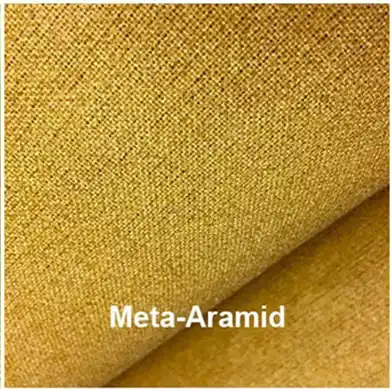
Meta-aramid fabric, commonly known by the brand name Nomex®, features molecular chains arranged in a “zigzag” or meta-position pattern. This arrangement makes it exceptionally stable under heat. When you are in a fire or a high-temperature industrial environment, Meta-aramid fabric protects you by rapidly carbonizing and thickening to form a thermal barrier.
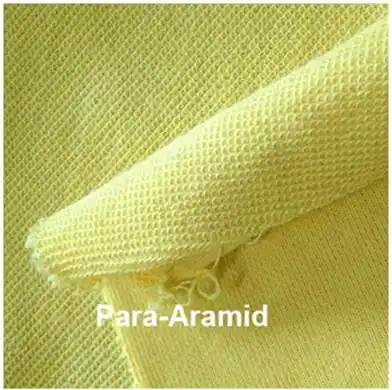
If you prioritize strength, Para-aramid fabric (such as Kevlar® or Twaron®) is your top choice. Its molecular chains are aligned in a parallel, linear fashion, giving it unimaginable tensile strength and stiffness. Weight for weight, it is 5 to 6 times stronger than steel. This makes it the only choice for making bulletproof vests, helmets, and reinforcements for composite materials.
| Performance Feature | Meta-aramid Fabric (1313) | Para-aramid Fabric (1414) |
|---|---|---|
| Primary Strength | Thermal Protection & Flame Retardancy | Extreme Strength & Impact Resistance |
| Molecular Structure | Zigzag (1,3 linkage) | Linear (1,4 linkage) |
| Typical Brands | Nomex®, Teijinconex® | Kevlar®, Twaron®, Technora® |
| Continuous Operating Temp | Approx. 200°C – 250°C | Approx. 190°C – 200°C |
| Decomposition Temp | Approx. 370°C – 400°C | Above 500°C |
| Elongation at Break | Higher (15% – 30%) | Very Low (2% – 5%) |
| Feel & Processing | Softer, easier to process | Stiffer, extreme rigidity |
Our aramid fabric is produced through a precise weaving process, ensuring consistent performance of the fibers under high stress. Our production line employs a strict tension control system, enabling the fabric to maintain a heat resistance of over 500°C while possessing superior dimensional stability compared to ordinary fabrics.

This is the most direct reason to choose aramid fabric. In aerospace or automotive manufacturing, you likely count every gram. Aramid fabric allows you to reduce weight while achieving strength superior to heavy metals. This means the race cars you build will be faster, and the planes you design will be more fuel-efficient.
You may need a material that does not melt even above 500°C. Aramid fabric has low flammability and an extremely high melting point, ensuring fabric integrity in extreme environments. Furthermore, it shows strong resistance to most organic solvents, fuels, and salts. While strong acids can damage it, it remains your sturdiest line of defense in most industrial chemical environments.
If you need to produce industrial gloves or durable workwear, the cut resistance and abrasion resistance of aramid fabric will impress you. Its fiber structure is incredibly tough, making it very difficult for sharp tools to cut through, providing you with excellent physical protection.
In the power or precision electronics industries, the non-conductive nature of aramid fabric is a property you must consider. As an excellent electrical insulator, it does not conduct electricity, giving you an extra layer of safety when dealing with live wires or designing high-temperature cables.
When you look around, you might be surprised to find that the applications for aramid fabric extend far beyond the traditional military field.

In aviation, you might find aramid fabric in aircraft wing leading edges, fuselage panels, and cabin interiors. Compared to carbon fiber, aramid fabric is more resilient and less prone to brittle failure during bird strikes. In the composite materials of the Boeing 787 Dreamliner, aramid fabric plays a key reinforcing role.
The efficiency of the vehicle you drive owes a lot to aramid fabric. It is used to reinforce tire sidewalls, create run-flat tires, and serves as a reinforcement layer for timing belts and hoses. Furthermore, in racing, aramid fabric is used to construct monocoque chassis, providing you with an almost indestructible survival cell in extreme accidents.
For you, the greatest application of aramid fabric is Personal Protective Equipment (PPE). From a firefighter’s flame-resistant turnout gear to a special forces member’s ballistic helmet and bulletproof vest, aramid fabric silently absorbs impact energy and blocks heat. For example, a lightweight aramid fabric known as CT 709 provides unprecedented comfort and flexibility for ballistic vests specifically designed for women.
The broadband optical cables in your home may contain aramid fabric yarns as strength members. In your leisure time, aramid fabric exists in your tennis rackets, badminton rackets, and even racing kayaks, enhancing your performance by providing extreme rigidity.
You might ask, why not choose cheaper polyester or nylon? When you compare them in the table below, you will understand the value of this investment.
| Fiber Name | Strength (g/denier) | Melting Point / Heat Resistance | Reaction to Fire | Elasticity & Stretch |
|---|---|---|---|---|
| Aramid Fabric (Para) | 20.0 – 27.0 | No melting point 500°C | Does not burn, self-extinguishing | Very low, extremely stable |
| Polyester (PET) | 6.5 – 9.0 | Approx. 250°C – 260°C | Melts and produces black smoke | Moderate |
| Nylon (Polyamide) | 8.0 – 9.0 | Approx. 190°C – 240°C | Melts and drips | Higher (easily deformed) |
When you need a material that does not lose strength at high temperatures or does not undergo permanent deformation under heavy impact, the performance of aramid fabric is incomparable to polyester and nylon. While nylon may feel softer, its vulnerability to heat (melting and dripping) could cause secondary injuries in an emergency.
Although aramid fabric is incredibly powerful, it does have its “Achilles’ heel.” To ensure your aramid fabric equipment lasts as long as possible, you need to keep two points in mind.
Here is a secret you must remember: Aramid fabric is highly sensitive to UV light. Prolonged exposure to sunlight will cause it to turn yellow and, more importantly, lead to fiber degradation, significantly reducing its strength. This is why many aramid fabric products (like fiber optic members or ballistic plates) are often wrapped in black plastic bags or treated with UV-resistant coatings.
When you need to clean your aramid fabric FR clothing or gloves, please follow these recommendations:
Use Neutral Detergents: Avoid chlorine bleach, as chlorine destroys the chemical structure of aramid fabric.
Strict Temperature Control: Use warm water for soaking and washing. Do not use high-heat drying to avoid unnecessary shrinkage.
Store in a Dark, Dry Place: When not in use, always store your aramid fabric products in a light-shielded, sealed container to extend their lifespan.
Not sure which type of aramid fabric is the most suitable for your project? We have a team of experienced technical engineers who can provide you with customized composite material reinforcement suggestions. Whether it’s for high-end bulletproof equipment, industrial sealing, or sports equipment reinforcement, our company can offer you one-stop support from material selection, prototyping to mass production. Contact our technical experts immediately to obtain the latest product manuals and quotations.

Connect with an NQ expert to discuss your product needs and get started on your project.
Contact NowWhat is the main difference between Kevlar® and Nomex®?
Think of Kevlar (para-aramid) as your “strength” hero—it is engineered specifically for high-impact resistance, making it ideal for bulletproof vests and high-tension ropes. Nomex (meta-aramid) is your “heat” hero—it is optimized for thermal stability and flame protection, which is why it is the go-to choice for firefighting suits and electrical insulation.
Why shouldn’t you leave aramid fabric gear in the sun?
You should avoid prolonged sunlight because aramid fabric is highly sensitive to ultraviolet (UV) radiation. UV rays cause a reaction called photodegradation, which turns the fibers yellow and, more importantly, can significantly weaken the material’s strength over time.
Can you use bleach to clean your aramid protective clothing?
No, you must never use chlorine bleach on your gear. Chlorine reacts with the molecules and destroys the chemical bonds that give the fabric its strength. To keep your aramid fabric safe, you should always use neutral detergents and warm water.
Is aramid fabric safe to use around high-voltage electricity?
Yes. One of the standout benefits of aramid fabric is that it is non-conductive. It acts as an excellent electrical insulator, which is why it is frequently used to protect high-temperature cables and is a requirement for workers facing electrical-arc hazards.
Can you dye aramid fabric to change its color?
It is extremely difficult to dye at home. Because the fibers are so dense and crystalline, they do not absorb standard dyes. Para-aramid is almost impossible to dye after it is manufactured and is usually “solution-dyed” (color added before the fiber is spun). Meta-aramid is slightly more receptive to color but still requires specialized high-pressure equipment.
Just how much stronger is aramid than steel?
On an equal weight basis, aramid fabric is approximately 5 to 6 times stronger than steel. While it offers incredible tensile strength, it weighs only about one-fifth as much as steel, allowing you to achieve maximum protection with minimal bulk.